
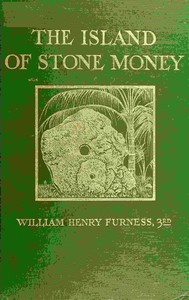
The island of stone money : Uap of the Carolines by William Henry Furness
Imagine sailing to a remote Pacific island in 1903. That's exactly what William Henry Furness did. The Island of Stone Money is his first-hand account of life on Uap (now called Yap), part of the Caroline Islands. He wasn't there as a conqueror or a missionary, but as an observer curious about the people and their customs. What he found was a culture operating on principles that seemed, to a Westerner, completely backwards and brilliant at the same time.
The Story
The heart of the book is the stone money, or rai. These aren't coins you can put in your pocket. They are huge, carved wheels of limestone, sometimes over twelve feet across. The crazy part? They're often too heavy to move from the spot where they were first placed. So, instead of physically exchanging them, ownership changes through public agreement and oral history. If you buy a canoe with a stone, the stone doesn't move. Everyone just knows it now belongs to the canoe seller. Furness walks us through how these stones are quarried on another island and perilously transported by canoe, how their value is determined (size, history, and even the drama involved in getting it), and how this system governs everything from marriages to resolving conflicts.
Why You Should Read It
This book stuck with me because it quietly dismantles what we assume is 'normal.' We think money has to be physical, portable, and countable. On Uap, it was communal, narrative, and rooted in trust. Furness writes with genuine wonder, not judgment. He describes the islanders' intelligence, their social structures, and their daily lives with a respect that was uncommon for his time. Reading it, you start to question the foundation of our own financial systems. Is our belief in the value of a dollar or a digital bank balance really that different from their belief in an immovable stone? It's a powerful reminder that economics is, at its core, a human story about agreed-upon value.
Final Verdict
This is a gem for curious minds. It's perfect for anyone interested in anthropology, economic history, or just incredibly good stories about human ingenuity. If you enjoyed books like Guns, Germs, and Steel or Sapiens but want something more focused and personal, you'll love this. It's a short, accessible read that packs a big intellectual punch. Don't expect a novel with a plot—it's a portrait of a place and an idea. But that idea, about the true nature of money, will rattle around in your head long after you finish the last page.
This title is part of the public domain archive. Access is open to everyone around the world.
Margaret Hernandez
9 months agoI decided to give this a try based on a colleague's recommendation, the argument presented in the middle section is particularly compelling. This should be on the reading list of every serious professional.
Lucas Lewis
1 year agoAs someone who reads a lot, the arguments are well-supported by credible references. I will read more from this author.



Ashley Wilson
1 year agoThe clarity of the introduction set high expectations, and the structural organization allows for quick referencing of key points. I'm genuinely impressed by the quality of this digital edition.