
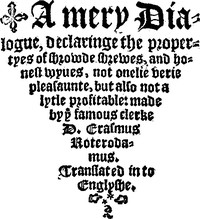
A Merry Dialogue Declaringe the Properties of Shrowde Shrews and Honest Wives
So, you pick up this book expecting a dusty old lecture. What you get is a full-blown, he-said-she-said argument from the 1500s. Erasmus, the rockstar humanist scholar of his day, decided to write about marriage not as a sermon, but as a conversation.
The Story
The whole book is a dialogue between two characters: Xanthippe and Eulalia. Xanthippe is named after the famously difficult wife of Socrates. She's loud, stubborn, and believes a wife should rule the roost. Eulalia, whose name means 'sweetly speaking,' is her polar opposite—the picture of quiet obedience and virtue. They go back and forth, point by point. Xanthippe argues that men are fools and women must be tough to manage them. Eulalia counters that a gentle, forgiving spirit is a wife's true strength and the key to a happy home. There's no narrator judging them; Erasmus just lets them talk. You're left listening in, deciding for yourself who makes more sense.
Why You Should Read It
Here's the cool part: it feels incredibly modern. This isn't just a one-sided manual for being a 'good wife.' By giving Xanthippe a real voice—a smart, fiery, and frankly funny voice—Erasmus lets us hear the other side of a story that usually went untold. You can feel the frustration of a smart woman in a world that told her to sit down and be quiet. When Eulalia talks about peace and patience, it doesn't always sound weak; sometimes it sounds like a clever strategy for survival. Reading it, you're not just learning what a man in the 1520s thought about women, you're hearing a simulated debate that reveals all the tensions of the time. It's a brainy, playful look at a fight that, in some ways, we're still having.
Final Verdict
This is a perfect little book for curious readers who love history but hate dry textbooks. If you enjoyed the marital sparring in Shakespeare's The Taming of the Shrew and want to see where some of those ideas came from, this is your backstage pass. It's also great for anyone interested in the history of everyday life, gender, or just brilliant, concise writing. Don't expect a plot with twists; expect a smart, short, and surprisingly spicy conversation that's been waiting 500 years for you to eavesdrop.
No rights are reserved for this publication. Share knowledge freely with the world.
Kimberly Harris
1 year agoFinally found a version that is easy on the eyes.
Christopher Jackson
1 year agoAfter a thorough walkthrough of the table of contents, the transition between theoretical knowledge and practical application is seamless. I'm glad I chose this over the other alternatives.
Michael Martinez
2 years agoI was skeptical about the depth of this book at first, but the quality of the diagrams and illustrations (if applicable) is top-notch. Truly a masterpiece of digital educational material.
Robert Gonzalez
7 months agoA brilliant read that I finished in one sitting.
Susan Wilson
4 months agoThe clarity of the concluding remarks is very professional.