
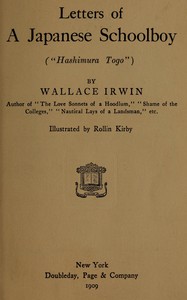
Letters of a Japanese schoolboy ("Hashimura Togo") by Wallace Irwin
So, what's this book actually about? Published in 1909, it's a collection of fictional letters. The writer is Hashimura Togo, a young Japanese man who has come to America for an education. He's writing back to his friend, the honorable Mr. K. Yamoto, in Japan, describing his adventures and misadventures.
The Story
There's no traditional plot with a beginning, middle, and end. Instead, each letter is a vignette. Togo tackles a different aspect of American culture, from the bewildering game of football (which he decides is a form of legalized combat) to the confusing rules of dating. He works odd jobs, observes political rallies, and tries to make sense of American slang, often interpreting it literally with hilarious results. His voice is a mix of wide-eyed wonder, polite confusion, and sly criticism, all filtered through his own cultural lens. He's not just a passive observer; he's actively trying to participate, which leads to most of the comedy and insight.
Why You Should Read It
Look, this book is a product of its time, and some of the humor is definitely dated (and can be cringe-worthy through a modern lens). But that's partly why it's fascinating. Togo isn't just a joke machine. Through his mangled English and unique perspective, Irwin—via Togo—is actually making some sharp points about American hypocrisy, consumerism, and social customs. You laugh with Togo as much as you laugh at the situations he describes. It's a clever satire wrapped in a comedic disguise. Reading it feels like finding an old, slightly cracked mirror that still reflects surprising truths about how we see ourselves and how others see us.
Final Verdict
This is a perfect pick for anyone interested in the history of satire, early 20th-century America, or immigrant narratives. If you enjoy Mark Twain's social commentary or the fish-out-of-water humor in books like The Innocents Abroad, you'll find a kindred spirit in Hashimura Togo. It's also a great, quick read for people who like their history lessons delivered with a wink and a nudge. Just go in knowing it's a period piece—enjoy the cleverness, question the stereotypes, and get ready to see 1909 America through the most uniquely confused tour guide imaginable.
This text is dedicated to the public domain. Enjoy reading and sharing without restrictions.
Mary Harris
10 months agoIt’s refreshing to see such a high standard of digital publishing.
Sarah Gonzalez
9 months agoVery satisfied with the depth of this material.
Amanda Ramirez
11 months agoTo be perfectly clear, the content flows smoothly from one chapter to the next. Thanks for sharing this review.
Ava Wright
1 year agoFrom the very first page, it manages to explain difficult concepts in plain English. Exceeded all my expectations.


George Martin
5 months agoExceptional clarity on a very complex subject.