
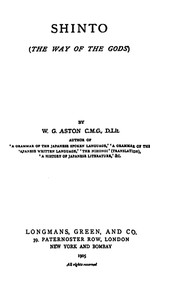
Shinto (the Way of the Gods) by W. G. Aston
Published in 1905, W.G. Aston's Shinto (the Way of the Gods) isn't a novel with a plot in the traditional sense. Its story is the story of an idea—the birth and evolution of Japan's indigenous spirituality. Aston, a scholar and diplomat, structures the book as a systematic exploration. He starts by defining what Shinto isn't, carefully distinguishing it from the Buddhism and Confucianism that later blended with it. From there, he reconstructs its core by examining its sacred texts (the Kojiki and Nihongi), its pantheon of gods (the kami), and its fundamental practices of purity, ritual, and connection to nature and ancestors.
The Story
The 'narrative' here is Aston's intellectual journey. He pieces together evidence from mythology, history, linguistics, and comparative religion to build a picture of early Shinto. He shows us a faith deeply tied to the natural world—where mountains, rivers, winds, and even rocks could be vessels for sacred spirits. He explains rituals of purification and offerings, and delves into the concept of kami, which are less like all-powerful gods and more like awe-inspiring, vital forces. The drama lies in watching him trace how this animistic, clan-based worship formed the spiritual bedrock of Japan, long before written records or organized priesthoods.
Why You Should Read It
You should read this if you want to go beyond just knowing what Shinto is and understand why it feels the way it does. Aston connects the dots in a way that makes so much of modern Japanese aesthetics and behavior click into place. The emphasis on cleanliness, the reverence for nature in art and gardens, the deep sense of respect—you see their proto-forms here. It's not a spiritual guide, but a cultural one. My favorite parts were where he uses word origins to explain concepts; it feels like unlocking a secret code. Yes, the language is of its time (early 1900s academic English), but his curiosity and respect for his subject shine through, making it more engaging than you might expect.
Final Verdict
This book is perfect for curious travelers, history buffs, anime and film fans who want deeper context, or anyone interested in the roots of world religions. It's not a light read, but it is a profoundly rewarding one. Think of it as the essential, slightly dusty, master key that opens the door to truly understanding a major pillar of Japanese culture. If you have the patience for a classic work of scholarship, Aston's Shinto remains an unmatched starting point.
This masterpiece is free from copyright limitations. Distribute this work to help spread literacy.
Liam Lee
1 year agoPerfect.
Mark Smith
3 months agoI had low expectations initially, however the content flows smoothly from one chapter to the next. A valuable addition to my collection.







Elijah Flores
3 months agoFive stars!